

The 75-Year Legacy Behind Nexco Pharma: From Kutapressin to Nexavir
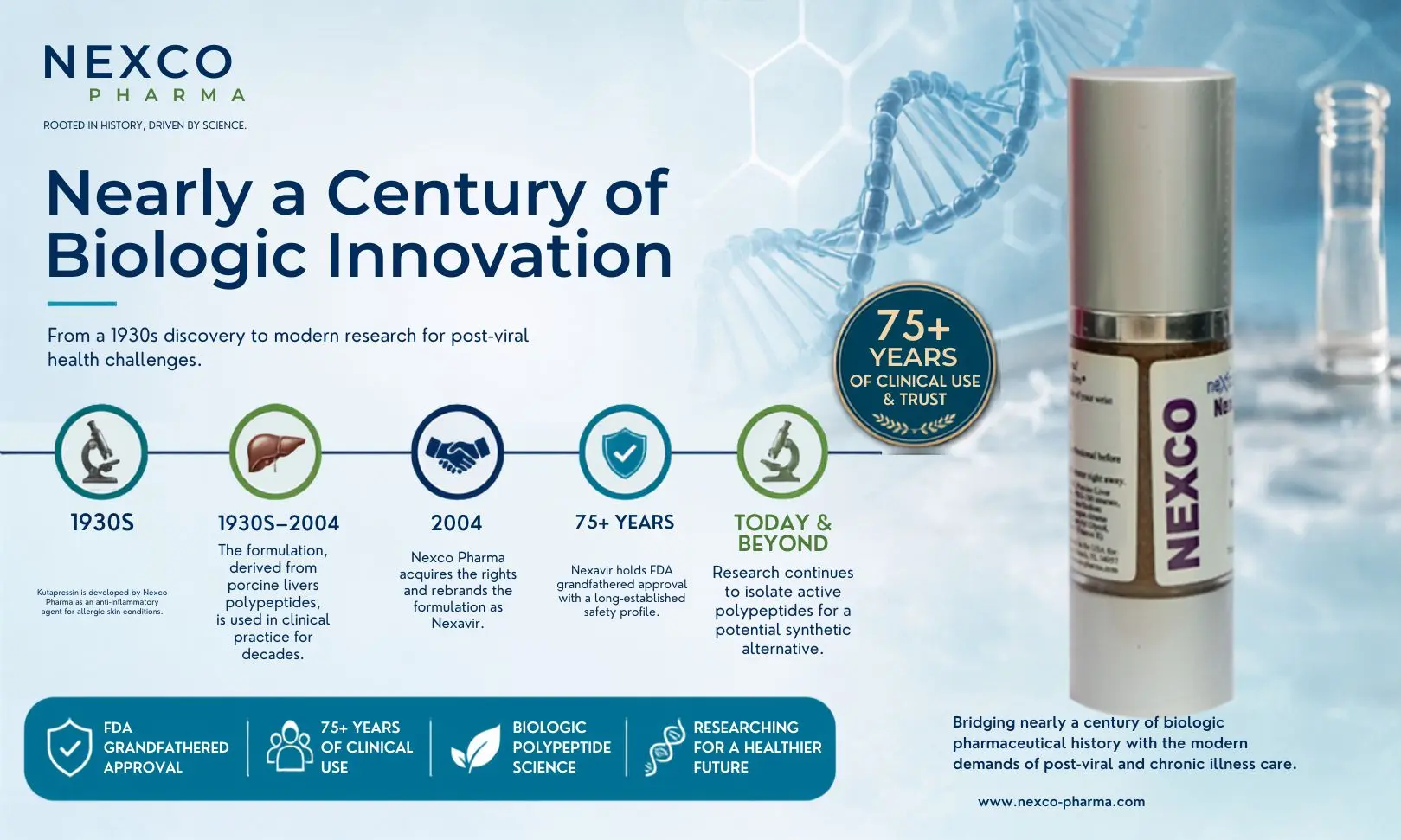
The landscape of modern medicine is constantly evolving, but sometimes the most profound breakthroughs are rooted in history. At Nexco Pharma, our foundation is built upon a nearly 100-year-old discovery that continues to inform modern therapeutic research today - a legacy that connects early 20th-century biologic science to today's most pressing post-viral health challenges.
The Origins in the 1930s
The story of our core innovation begins in the 1930s, when a compound named Kutapressin was originally developed by Kremers Urban (later Schwarz Pharma). It was used as an anti-inflammatory agent, primarily for acute allergic reactions of the skin - including severe contact dermatitis (such as poison ivy), shingles, and rosacea.
This formulation consisted of a processed extract derived from porcine livers, yielding a unique mixture of small proteins known as polypeptides - a class of naturally occurring biologic compounds that continues to draw scientific interest today for their anti-inflammatory and antiviral potential.
Why Polypeptide Science Still Matters Today
Polypeptides are short chains of amino acids that occur naturally in biological tissue. Because they're derived directly from living systems rather than synthesized in a lab, biologic polypeptide compounds like the one behind Nexavir offer researchers a different lens into how the body's own processes can support recovery from viral and inflammatory stress. This is part of why interest in natural antiviral compounds and biologically derived therapeutics has only grown as post-viral conditions like Long COVID have become a modern public health focus.
The Nexco Pharma Acquisition
Recognizing the potential of this biologically derived compound, Nexco Pharma acquired the rights to it in 2004 and rebranded the same formulation as Nexavir.
Over its 75-year history, it has built a long-established safety profile, and no significant safety concerns have been identified in that time. (Individuals with pork allergies should not use Nexavir.)
Guided by Science, Looking to the Future
We've gathered significant clinical insight into Nexavir over the past three decades, and our research teams are now working to isolate and characterize its active polypeptides. Our long-term vision is to better understand this formula's mechanism of action with the goal of one day developing a scalable, non-biological synthetic alternative that could make this legacy therapy more accessible worldwide.
We remain committed to exploring this legacy responsibly, grounded in history and guided by ongoing scientific research bridging nearly a century of biologic pharmaceutical history with the modern demands of post-viral and chronic illness care.
Nexco Pharma's manufacturing and research practices are backed by our certifications and regulatory credentials — learn more about the standards behind our formulations.https://www.nexco-pharma.com/credential-certificates
FAQ
Kutapressin is the original name of the compound developed in the 1930s by Kremers Urban. Nexco Pharma acquired the rights to this same formulation in 2004 and rebranded it as Nexavir.
Nexavir is a processed extract derived from porcine (pig) liver, yielding a mixture of small proteins known as polypeptides.
Nexavir has a long-established safety profile built over 75 years of clinical use, with no significant safety concerns identified in that history. Individuals with pork allergies should not use Nexavir.
Polypeptides are short chains of amino acids found naturally in biological tissue. As a biologic compound (rather than a synthetic one), they're of ongoing research interest for their potential anti-inflammatory and antiviral properties.
Our research teams are working to isolate and characterize Nexavir's active polypeptides, with the long-term goal of developing a scalable, non-biological synthetic alternative.